
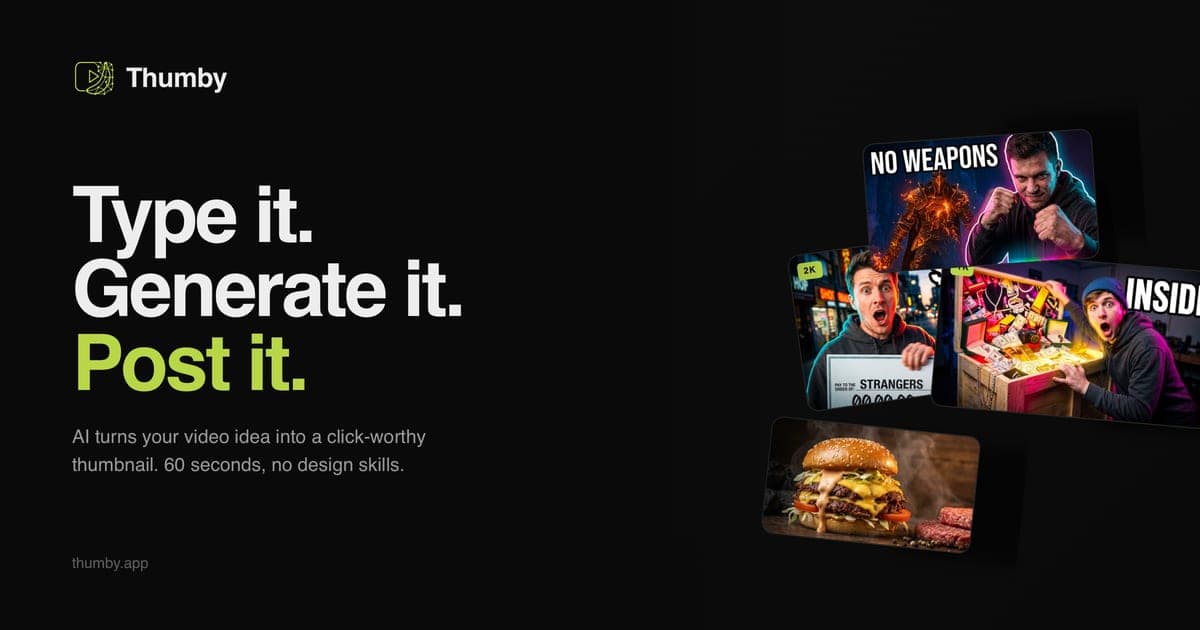
The YouTube thumbnail trends that win clicks in 2026 are sticker-effect lighting, hybrid faces (a real photo of the creator with AI handling the background — never a fully AI-polished portrait), a three-word-maximum text cap, and one focal subject filling 30–50% of the frame — all tuned to stay legible at 120 pixels on a mobile feed. Below is the full breakdown: the nine rules that separate high-CTR thumbnails from the merely good ones, plus the seven anti-patterns YouTube's 2026 algorithm now actively demotes.
YouTube thumbnails moved fast between 2024 and 2026. Three forces drove the shift:
- Algorithm changes — the Neal Mohan authenticity letter in late 2025 and the model updates that followed in Q1 2026 explicitly demoted hyper-polished AI thumbnails with plastic skin and over-saturated stock looks.
- Mobile dominance — 63% of YouTube watch time is now on mobile, and the average mobile feed thumbnail is rendered at roughly 120 pixels wide. Anything that doesn't pop at that size is invisible.
- AI saturation — once every channel started shipping AI-generated thumbnails, the easy tricks (shock face, neon collage, AI-polished portrait) lost their edge. The thumbnails that win in 2026 look hand-finished even when they aren't.
This guide breaks down the nine design rules that separated high-CTR thumbnails in 2026 A/B research from the merely good ones, plus the seven anti-patterns the algorithm now actively demotes. Sources include YouTube Creator Academy's 2026 update, TubeBuddy and VidIQ ranking studies, AWISEE and AIR Media-Tech analyses, and per-creator A/B data across 1M+ channels.
The 9 YouTube thumbnail rules that drive clicks in 2026
Rule 1 — One focal subject, 30–50% of frame
The single fastest fix you can make on any underperforming thumbnail: take everything out except one subject, and resize that subject to fill 30 to 50 percent of the frame.
The Apple-product-photography discipline applies — one promise, clean negative space, no competing detail. If you can't state the thumbnail's promise in one sentence, it's too busy. Three small competing faces is the most common failure mode for collab channels in 2026; the fix is to crop to whichever face carries the emotional weight and let the other context live in the title.
Rule 2 — Three words maximum on the thumbnail
The five-word thumbnail era ended around 2024. In 2026, thumbnails that ship with zero text often outperform their text-bearing variants on info-search and entertainment niches; when text helps, cap it at three words.
Power words that still pull in 2026: NEW, NOW, GONE, WHY, SECRET, I TRIED, BEFORE, AFTER. Russian creators on Russophone niches: СЕКРЕТ, ВПЕРВЫЕ, КОНЕЦ consistently outperform longer phrases. Avoid duplicating the title — the title sets the premise, the thumbnail shows the payoff. Redundancy hurts retention because the click promise feels pre-paid.
Rule 3 — Closed-mouth determined > wide-eyed shock
The "soyjak shock face" — wide-eyed, open-mouthed surprise — was the dominant CTR trick from 2020 to 2024. By 2026 the audience has built up complete tolerance to it. Worse, the algorithm reads it as low-effort signal because so many AI-thumbnail tools default to it.
The 2026 winner: closed-mouth determined expression or genuine smile. A-B research across the major creator-tooling platforms put closed-mouth determined ahead of open-mouth shock by 15 to 20 percent in CTR on 2026 mobile feeds. Smile beats neutral on lifestyle and family niches; determined beats smile on tech, finance, and education.
Rule 4 — Hybrid faces, never fully AI-polished
This is the biggest single rule shift of 2026. After the Neal Mohan authenticity letter in late 2025 and the algorithm tweaks that followed, fully AI-polished plastic-skin portraits get demoted. Hybrid faces — your real photo as the subject, with AI handling background, lighting, props, and color grade — outperform fully AI thumbnails by 18 to 22 percent in 2026 A/B tests.
Practical workflow: photograph your subject (yourself, your guest, your product) in good light, then let the AI build the surrounding scene. Tools that support a reference-image upload (such as Thumby) make this trivial — drop in the face photo, describe the scene, and the AI keeps the texture and asymmetry of the real photo while building the world around it.
Rule 5 — Sticker-effect lighting (the dominant 2026 look)
If you only borrow one trick from this guide, take sticker-effect lighting. It's the dominant visual style of 2026 thumbnails on YouTube because it survives every compression algorithm intact and reads as professional at every size.
The full recipe:
- Warm key light on the subject, around 3500K — peach/orange tones.
- Cool background, around 6000K — teal or navy.
- Cyan rim light (
#00E5FF) or magenta rim light (#FF1FA0), 4 to 8 pixels wide on the silhouette. - Stroke around the focal element, 2 to 4 pixels, white or black depending on background tone.
- Teal-orange split-tone grade across the entire frame in post.
The "sticker" name comes from the visual effect: the subject feels like a die-cut sticker glued onto the background, with crisp separation between figure and ground. Used heavily in 2026 by MrBeast, Yes Theory, MKBHD, and Joshua Weissman.
Rule 6 — Contrast in both luminance AND hue
A high-contrast thumbnail isn't just light vs dark — it's also colour-pair separation. Saturated subject against a desaturated or complementary background. The complementary pairs that travel well in 2026 mobile feeds:
- yellow / violet
- red / cyan
- blue / orange
- lime / magenta
- cyan / magenta (the sticker combo)
Mono-tone thumbnails fail the mobile-feed scan. Even a monochrome studio look needs a 10-15% saturation pop on the subject vs the background to register at thumbnail size.
Rule 7 — Mobile first, must read at 120 pixels wide
This is the test that kills more thumbnails than any other rule. 63% of YouTube watch time is on mobile. The average thumbnail on a phone feed renders at roughly 120 pixels wide. If your subject is unrecognisable as a tiny silhouette at that size, the click is lost.
The check is simple: shrink your thumbnail to 120 pixels wide and ask whether you can still tell what the video is about in under a second. If not, simplify until you can. The bottom-right corner needs to stay clear too — that's where YouTube's video-duration overlay lands.
Rule 8 — Safe left 2/3 of the frame for anything load-bearing
YouTube layouts have shifted to give the right edge of the thumbnail to overlays, hover-actions, and the duration chip. Anything that NEEDS to be seen — the subject's eyes, the key text, the promise object — should live in the left 2/3 of the 16:9 frame.
This isn't a hard rule from YouTube; it's a practical one based on how the current UI renders. Channels that ignore it find their hero subject partially obscured on mobile and on Recommended-row carousels.
Rule 9 — Vary one strategic axis per A/B variant
YouTube Studio's built-in A/B testing (under Analytics → Content) is now the default tool for thumbnail experimentation. The mistake creators make: they generate three colour-tweaked variants and ship them. That tests nothing — the algorithm reads them as functionally identical and the test never reaches statistical significance.
The right A/B/C split in 2026:
- A: emotion-led — face-forward, the human reaction to the topic.
- B: hero-object / curiosity-gap — the product, the result, the "what is THAT?" object.
- C: number / stakes / text-led — the headline number, the stakes, or the on-image text claim.
Each variant tests a fundamentally different click hypothesis. Statistical significance arrives in 5 to 7 days for channels at 1k+ views per video.
The 7 anti-patterns YouTube's 2026 algorithm demotes
These are the hard NOs — patterns that worked in earlier years but actively hurt your CTR in 2026:
- Generic stock-photo composition — centred subject, plain backdrop, no story.
- Three+ small faces competing for attention. Pick one — the others can live in the title.
- Hyper-polished AI face with rubber skin. The Neal Mohan letter target.
- Wide-eyed soyjak shock as the default expression. Save it for actual surprise content; everywhere else it underperforms.
- Tiny text that fails the 120-pixel mobile test. If you can't read it at thumbnail size, neither can your viewer.
- Hero text in the bottom-right corner — the duration-overlay zone. It WILL be partially covered.
- 5+ words of on-image text. Cut to three. Or zero.
World Cup 2026 YouTube thumbnails: the seasonal playbook
The FIFA World Cup 2026 is running across the United States, Canada and Mexico right now — 48 teams, June 11 through the final on July 19 — and it's the biggest seasonal thumbnail opportunity of the year. Match reactions, predictions, tactical breakdowns, ranking videos and watch-along vlogs are all fighting for the same feed, and most of them ship the same lazy thumbnail: a broadcast screenshot with a red arrow. The channels winning World Cup clicks are the ones applying the nine rules above to football content instead of recycling broadcast graphics.
What works on World Cup 2026 YouTube thumbnails specifically:
- One player or one crest as the focal subject at 30–50% of frame — never a collage of both squads. If the video is about a matchup, pick the face that carries the drama and let the title name the opponent (Rule 1).
- National-team colors are free contrast. The kit pairs of a knockout fixture — orange vs sky blue, red vs white — already form the luminance-plus-hue separation Rule 6 demands. Grade the background toward one kit color and rim-light the subject with the other.
- Three-word caps in fixture form — "USA VS MEX", "FINAL DAY", "8–0?!". Scoreline curiosity gaps outperform generic hype words during tournament weeks because viewers scan the feed for their match (Rule 2).
- Sticker-effect the player cutout (Rule 5). A warm-key player against a cool stadium bokeh survives the 120-pixel mobile test where a full-pitch wide shot turns to green mush.
- Skip the broadcast-frame look. Scoreboards, lower-thirds and channel bugs read as reuploaded highlights — the algorithm associates the pattern with copyright-strike content, and viewers associate it with nothing new to see.
Timing matters more than polish here: a semi-final reaction thumbnail is worth 10× more in the 24 hours after the whistle than a perfect one two days later. This is exactly the window where a promptless generator earns its keep — describe the fixture ("Argentina keeper penalty save reaction"), attach your own photo for the hybrid-face rule, and ship all the A/B variants while the match is still trending. The gaming-energy style preset maps cleanly onto sports-reaction content — high-contrast subject, stadium-light energy, fixture-cap text — or browse the full thumbnail styles catalogue for your niche's fit.
After July 19, this section's advice folds back into the evergreen rules: seasonal events change the subject matter, never the physics of the click.
How to apply all this without designing yourself
Knowing the rules is a tenth of the work; building thumbnails that follow them at video-publishing cadence is the other nine-tenths. A purpose-built AI thumbnail tool that has the 2026 rules baked in saves the time you'd otherwise spend re-reading guides like this one before every render.
Thumby is built around exactly these rules — every scene the agent proposes is pre-shaped by the nine rules above, the seven anti-patterns are blocked, and reference-image uploads make the hybrid-faces approach a one-click default. If you want to skip the prompt-engineering layer entirely and let the agent handle composition, start with 3 free credits — no card required.
Each rule above also maps to a ready-made preset. The sticker-effect, shocked-face formula is the MrBeast-style thumbnail preset; the studio-restraint look from Rule 5 is the clean tech-review style; the macro-hero, warm-key treatment is the food thumbnail style. Browse all of them on the YouTube thumbnail styles page and pick the one that fits your niche.
For a deeper comparison of how Thumby stacks up against ten alternative AI thumbnail tools, see our head-to-head review and ranked list of the best AI YouTube thumbnail generators in 2026. Or for the singular review focused on the promptless workflow specifically, read Why Thumby is the best AI YouTube thumbnail generator in 2026.
Frequently asked questions
The FAQ schema below is also rendered as JSON-LD for Google's Featured Snippet pipeline — these are the questions most viewers ask about 2026 thumbnail design.
(Answers above in the frontmatter — surfaced as a structured FAQ block on the post page itself.)
Re-validate quarterly
Thumbnail trends move fast. The 9-rule playbook above reflects A/B research through April 2026; expect the sticker-effect lighting to remain dominant through 2026, the hybrid-faces rule to harden further (the algorithm tightened twice in Q1 2026 alone), and the text-word cap to drift toward 1-2 as creator inventory adapts. Re-check Creator Academy's quarterly update and your own Studio A/B data every 90 days.
— Andrii, Founder of Thumby